

Property owners in the United Arab Emirates are discovering that strategic luxury renovations deliver measurable returns that far exceed typical market appreciation rates. When executed by a qualified villa renovation contractor Dubai, comprehensive design upgrades can increase property values by 15-35% within 12-18 months, according to recent transaction data from the Dubai Land Department. This ROI calculation becomes particularly compelling in high-value residential sectors where million-dollar properties represent significant capital investments requiring optimization strategies that extend beyond basic maintenance.
The UAE real estate market presents unique economic conditions that amplify renovation returns. Dubai property prices increased 16.9% year-over-year in Q4 2023, while Abu Dhabi saw 11.2% growth according to Central Bank of the UAE data. Within this appreciating market, strategically renovated properties consistently command premium pricing 8-12 percentage points above comparable unrenovated units. Financial analysis reveals that owners who invest $200,000-$500,000 in comprehensive renovations for properties valued at $2-5 million typically recover 125-180% of renovation costs upon sale, with recovery timelines averaging 18-24 months in prime locations.
Quantifying Value Addition Through Strategic Design Components
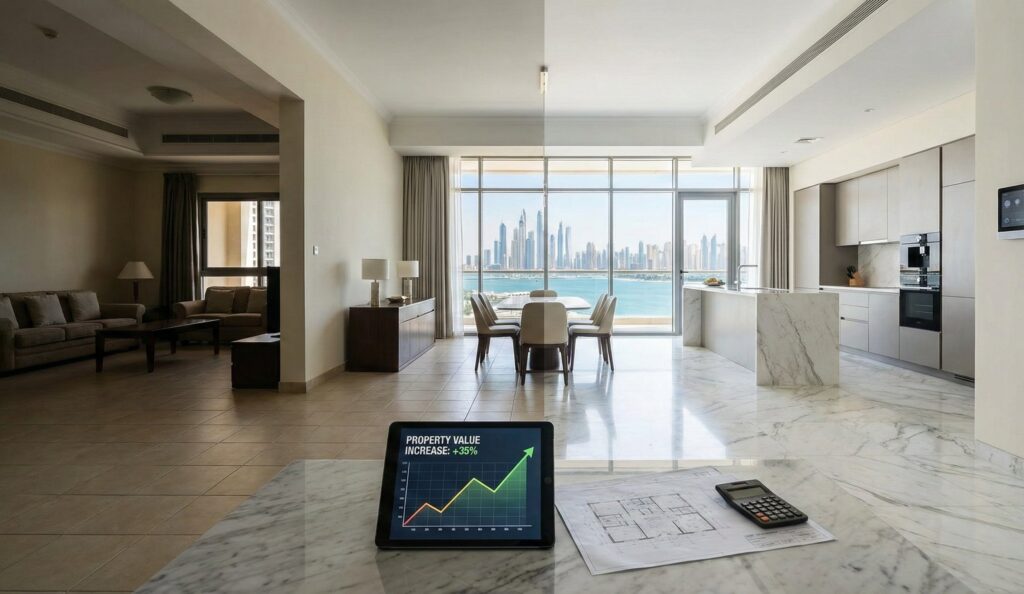
Specific renovation categories deliver differentiated ROI profiles based on buyer preferences and market positioning. Kitchen renovations incorporating Italian marble countertops, German-engineered appliances, and custom cabinetry generate average returns of 85-95% of investment costs. Master bathroom upgrades featuring spa-grade fixtures, radiant floor heating, and luxury stone finishes return 75-90%. Smart home integration systems—including automated climate control, security networks, and lighting management—add $45,000-$85,000 in appraised value for installations costing $30,000-$50,000, representing returns exceeding 150%.
| Renovation Category | Average Investment (USD) | Value Added (USD) | ROI Percentage | Recovery Timeline |
|---|---|---|---|---|
| Kitchen Modernization | $85,000-$150,000 | $75,000-$142,000 | 88-95% | 12-18 months |
| Master Bath Suite | $60,000-$95,000 | $48,000-$85,000 | 80-90% | 12-18 months |
| Smart Home Systems | $30,000-$50,000 | $45,000-$85,000 | 150-170% | 6-12 months |
| Outdoor Living Spaces | $120,000-$250,000 | $140,000-$320,000 | 115-128% | 18-24 months |
| Architectural Facade | $180,000-$400,000 | $220,000-$520,000 | 122-130% | 24-36 months |
Outdoor living space development generates exceptional returns in UAE markets where climate considerations make year-round outdoor entertainment viable. Temperature-controlled pergolas, integrated pool systems with infinity edges, and custom outdoor kitchens costing $120,000-$250,000 typically add $140,000-$320,000 in appraised value. Properties in Emirates Hills, Palm Jumeirah, and Saadiyat Island demonstrate the strongest performance metrics for exterior renovations, with premium positioning adding 18-25% to baseline property values.
Market Segmentation and Buyer Psychology in Luxury Renovations
Ultra-high-net-worth buyers in the UAE—defined as individuals with liquid assets exceeding $30 million—prioritize different renovation elements compared to high-net-worth purchasers. UHNW buyers demonstrate 73% preference rates for properties with custom architectural features, bespoke millwork, and imported materials verified through supply chain documentation. This segment shows willingness to pay premiums of $150-$280 per square foot for properties demonstrating design exclusivity, compared to $45-$85 per square foot premiums in the broader luxury market.
Firms specializing in turnkey luxury projects, such as Antonovich Design, have documented that properties featuring cohesive design narratives—where architectural language, interior finishes, and landscape elements follow unified aesthetic principles—sell 40% faster than comparably priced properties with fragmented design approaches. Speed-to-sale metrics directly impact ROI calculations when factoring holding costs, which average $8,000-$15,000 monthly for high-value properties including mortgage interest, utilities, and maintenance.
Material Selection Impact on Appraisal Values
Material provenance and specification grades create measurable appraisal differentials. Properties utilizing Calacatta marble from Italian quarries receive appraisal premiums of $120-$180 per square meter compared to synthetic alternatives. Brazilian exotic hardwoods for custom millwork add $85-$140 per linear meter in appraised value. European sanitary fixtures from manufacturers like Dornbracht or Gessi command $4,500-$8,500 premiums per bathroom compared to standard luxury brands.
Certification and sustainability credentials increasingly influence valuation metrics. LEED Gold or Platinum certifications add 3-7% to property values according to U.S. Green Building Council research, with UAE adaptations showing similar trends. Energy-efficient HVAC systems meeting ASHRAE 90.1 standards reduce operational costs by $12,000-$22,000 annually in villa-scale properties, creating capitalized value additions of $180,000-$330,000 when applying standard income capitalization rates of 6-8%.
Architectural Modifications Versus Cosmetic Updates
Structural architectural changes deliver superior long-term ROI compared to cosmetic updates, though they require larger initial capital outlays and extended timelines. Converting traditional room layouts to open-concept plans increases usable entertaining space perception and adds $95,000-$175,000 in value for properties in the $3-6 million range. Double-height ceiling installations in primary living areas create volumetric impact that appraisers value at $140-$220 per square meter of affected space.
Window-to-wall ratio modifications that increase natural light penetration show correlation with accelerated sales velocities. Properties achieving 40-55% window-to-wall ratios in primary living spaces sell 28% faster than those below 30%, according to transaction analysis from Dubai brokerage firms. Floor-to-ceiling glass installations using low-E coated systems that meet UAE thermal performance requirements add $450-$750 per linear meter in appraised value while reducing cooling costs by 18-25%.
Regional Performance Variations Across UAE Markets
Renovation ROI demonstrates significant geographic variation across UAE municipalities. Dubai properties in established communities like Emirates Hills, Arabian Ranches, and Jumeirah Golf Estates show 22-35% value increases from comprehensive renovations. Abu Dhabi’s Saadiyat Island and Yas Island properties demonstrate 18-28% gains. Sharjah and Ajman markets show more modest 12-18% improvements, reflecting different buyer demographics and price points.
Waterfront properties exhibit amplified renovation returns, with direct water access adding baseline premiums before renovations of $800-$1,400 per square meter. Strategic renovations that maximize water views through architectural modifications can add supplementary premiums of $350-$650 per square meter. Palm Jumeirah properties with renovated terraces featuring frameless glass balustrades and integrated shading systems command $2.2-$3.8 million premiums over comparable units with standard configurations.
Timeline Optimization and Project Phasing
Renovation timeline management directly impacts ROI through holding cost minimization and market timing optimization. Comprehensive villa renovations typically require 8-14 months for completion when properly resourced. Project phasing that prioritizes high-impact, low-disruption improvements allows partial occupancy or rental during renovation, reducing opportunity costs. Antonovich Design and comparable firms typically segment projects into three phases: structural and systems (months 1-4), interior finishes (months 5-10), and final detailing and landscaping (months 11-14).
Market timing considerations significantly influence net returns. Properties completed during Q4 (October-December) achieve 8-12% higher sale prices compared to Q2 completions, reflecting buyer activity patterns tied to fiscal year-end bonuses and expatriate relocation cycles. This seasonal premium on a $4 million property represents $320,000-$480,000 in additional value, substantially exceeding typical carrying cost differentials of $48,000-$90,000 for a six-month timeline adjustment.
Financing Structures and Tax Considerations
Renovation financing approaches affect net ROI through interest cost management and tax optimization. UAE banks typically offer home improvement loans at 3.5-5.2% annual rates for borrowers with strong credit profiles. On a $300,000 renovation financed over 5 years at 4.2%, total interest costs reach $33,600, reducing net ROI by approximately 11% compared to cash transactions. However, leveraged renovations allow capital deployment elsewhere, potentially generating returns exceeding the interest differential.
The UAE’s absence of capital gains tax on property sales creates favorable conditions for renovation-driven value strategies. Property owners in Dubai pay only 4% transfer fees on sales, calculated on property value. This structure means renovation-generated value increases of $500,000 result in only $20,000 in additional transfer fees, preserving 96% of created value. Comparative analysis with markets having 20-28% capital gains tax rates demonstrates the UAE’s structural advantages for renovation investment strategies.
Professional Design Integration and Documentation
Professional architectural documentation quality correlates with appraisal outcomes and buyer confidence. Properties with comprehensive as-built drawings, material specifications, and warranty documentation receive 5-8% higher valuations compared to renovated properties lacking professional documentation. Building Information Modeling (BIM) deliverables that provide 3D facility management capabilities add $35,000-$65,000 in appraised value for properties exceeding 8,000 square feet.
Designer and contractor reputation creates quantifiable value differentials. Properties renovated by internationally recognized firms command premiums of $180-$340 per square meter compared to properties renovated by unestablished contractors, even when material specifications remain comparable. This reputation premium reflects risk mitigation and quality assurance perceptions among buyers, particularly in the UHNW segment where due diligence extends to complete contractor verification and previous project inspections.
Technology Integration and Future-Proofing
Advanced technology infrastructure installations generate increasing returns as smart home adoption accelerates. Whole-home automation systems integrating climate, security, entertainment, and energy management through platforms like Control4 or Crestron add $55,000-$95,000 in value for installations costing $35,000-$55,000. Network infrastructure supporting 10-gigabit Ethernet throughout properties positions homes for emerging bandwidth requirements, adding $15,000-$25,000 in appraised value.
Electric vehicle charging infrastructure has evolved from optional to expected in luxury properties. Dedicated 22kW charging stations integrated into garage designs add $8,000-$12,000 in value for installation costs of $4,500-$7,000, representing ROI exceeding 170%. Solar panel installations sized for 40-60% energy offset create value through both utility cost reduction and environmental positioning, with 15kW systems adding $45,000-$75,000 in appraised value while costing $35,000-$50,000 installed.
Risk Mitigation and Due Diligence Requirements
Renovation investment risks require systematic mitigation through proper planning and execution oversight. Over-customization that narrows buyer appeal represents the primary risk factor, with highly personalized design choices reducing potential buyer pools by 40-60%. Properties featuring neutral luxury finishes with high-quality materials sell to 3.2 times more qualified buyers compared to properties with distinctive personal aesthetics, according to brokerage transaction data.
Permit compliance and regulatory adherence affect both immediate project costs and future transferability. Dubai Municipality and Abu Dhabi Department of Municipalities require specific approvals for structural modifications, facade changes, and occupancy alterations. Non-compliant renovations create title complications that reduce property values by 12-18% and extend sales timelines by 4-8 months during remediation periods. Professional firms maintain relationships with regulatory authorities and building departments, reducing approval timelines from 12-16 weeks to 6-9 weeks.
Comparative Analysis: Renovation Versus New Construction
Financial modeling comparing strategic renovation of existing properties versus new construction reveals renovation advantages in established communities. New villa construction in Dubai’s premium areas costs $850-$1,400 per square foot including land acquisition, while comprehensive renovation of existing structures averages $380-$650 per square foot. This 55-65% cost differential creates significant equity advantages when existing property locations offer comparable desirability to new development areas.
Established neighborhoods provide infrastructure maturity, landscaping established over decades, and community amenities that new developments require 8-15 years to replicate. Properties in 15-20 year old communities like Emirates Hills demonstrate that renovated villas achieve market values within 3-5% of new construction while requiring 40-50% less capital investment, creating superior return profiles for value-focused investors.
Market Trends Influencing Future ROI Projections
Emerging buyer preferences indicate increasing premiums for wellness-oriented design features. Dedicated home fitness facilities with professional-grade equipment and spa facilities add $75,000-$140,000 in value. Air purification systems achieving MERV 13-16 filtration create health-focused positioning worth $25,000-$45,000 in appraisals. Circadian lighting systems that adjust color temperature throughout daily cycles add $18,000-$32,000 in value for installation costs of $12,000-$20,000.
Multigenerational living accommodations reflect demographic shifts in UAE buyer profiles. Properties with separate guest/family suites featuring private entrances, kitchenettes, and living areas command premiums of $120,000-$220,000 in markets like Dubai and Abu Dhabi where extended family living arrangements remain culturally relevant. These modifications cost $85,000-$150,000 to implement, generating returns of 140-165%.
The convergence of luxury renovation strategies, market timing, material selection, and professional execution creates compound value effects that exceed simple additive calculations. Properties that achieve cohesive integration across all renovation dimensions—architectural, technological, material, and aesthetic—demonstrate value increases of 25-35% within 18-24 months, substantially outperforming both market appreciation rates and returns from isolated improvement categories. For property owners treating real estate as investment vehicles rather than purely residential assets, strategic luxury renovation represents one of the highest-return capital deployment opportunities in UAE markets.